As last week’s rare earth export controls illustrate, China sees industrial capacity as core to its national power. After decades of offshoring, America now dreams of reindustrialization, partly driven by a fear that its hollowed-out industrial base couldn’t compete in a protracted conflict. Before the rare earth moves, I reread Stefan Link’s great book Forging Global Fordism, a history of industrial capacity and geopolitical power in the mid 20th century. It’s even more relevant than when it was published five years ago.

The 1930s are usually seen as a “retreat from globalization,” but during the 1930s the world’s great powers all built their own copies of the era’s most important manufacturer: Ford Motor Company. Germany, Japan, Italy, and the USSR all pursued this with aggressive technology transfer requirements, with engineers trained in U.S. auto firms, with the de facto support of Ford, and with a willingness to spend whatever it took to build their own Detroits.
The depression saw a collapse in trade, but an increase in tech transfer. It wasn’t a “retreat from globalization,” Link argues, but “an era of furious and consequential attempts to transform its very structure.” That’s why, as one economist at the time noted, “the depression did not halt the industrial revolution, but actually…accelerated it.”
The leading thinkers of the countries that would challenge America in World War II all thought that Henry Ford was the most important figure of the age. Autos were the ultimate high tech good, requiring precision manufacturing and complex supply chains.
The auto industry was the backbone of the mid-20th century industrial base. In 1937, according to Link, “the auto industry consumed one-fifth of all steel produced in the USA, more than half of all malleable iron, four-fifths of crude rubber, almost a third of its lead, and a good part of its precious metals. One out of seven Americans relied for employment on the industry and its supply chains.”
In the 1920s and 30s, America was staggeringly dominant in car manufacturing. North American auto producers made 10 times the number of cars as the UK. Before 1927, when the USSR began trying to replicate Ford, the Soviets had made “a few hundred vehicles.” The entire Soviet auto fleet—cars made or purchased—was 18,000. Poland had 16,000. The U.S. had 22 million.
Anyone who wanted to challenge America had to challenge its dominance in autos. Adam Tooze has noted how Nazis admired and feared the US industrial base and its “gigantic state with infinite production capacities,” as Hitler put it. Stalin argued that “to remain on this level of development…[risked being] an appendage of the. capitalist system.” Trotsky wanted to “separate Fordism from Ford…[to] socialize and purge it.”
How to build a car industry? Tech transfer and localization requirements. Take Japan: “In 1936 the government passed the notorious Automobile Manufacturing Enterprise Law, a measure that discriminated against the American firms, penalized imports of vehicles, and encouraged Nissan and Toyota—weak and inexpert producers compared to the Americans—to expand investments and update their technologies. These measures eventually forced GM and Ford to exit the Japanese market and allowed Nissan and Toyota to acquire the Americans’ factory machinery and hire their workers and engineers.”
The same happened in Europe. In 1929 “Mussolini personally thwarted an attempt by Ford to expand its presence in Italy,” building up Fiat instead. “Ford and GM established full manufacturing plants in Britain, Weimar Germany, France and Scandinavia…the Americans faced stiff headwinds from an alliance of domestic firms and governments who compelled them to qualify as ‘national’ producers by increasing national ownership and sourcing a high share of locally produced supplies.”
Though the Germans, Italians, Japanese, and Soviets realized that an auto-industrial base was a dual-use good, the Americans mostly didn’t—or at least, corporate leaders chose not to consider the consequences. Even setting aside Ford’s personal politics, I was struck by the open door Detroit gave countries that wished to replicate and replace it. In summer 1937—with fascism on the march in Spain and across Europe—Ferdinand Porsche spent three weeks in Detroit “all over the Ford plant,” he reported, finding it “the most wonderful factory I have ever seen.” In hindsight, helping build the Nazi auto industry doesn’t look very smart. (IBM—a company whose boss was as naive as Ford about the Nazi threat—was equally helpful in building Germany’s early computer industry, as this excellent book shows.)
The Soviets—even when Stalin’s program of crash industrialization and rural famine were in full swing—were given comparable open door treatment, with Ford executive Charles Sorensen saying that he allowed Soviet visitors “full access to everything we were doing.” Some leftist American auto workers engineers returned or emigrated to the USSR to build a car industry in the homeland of socialism.
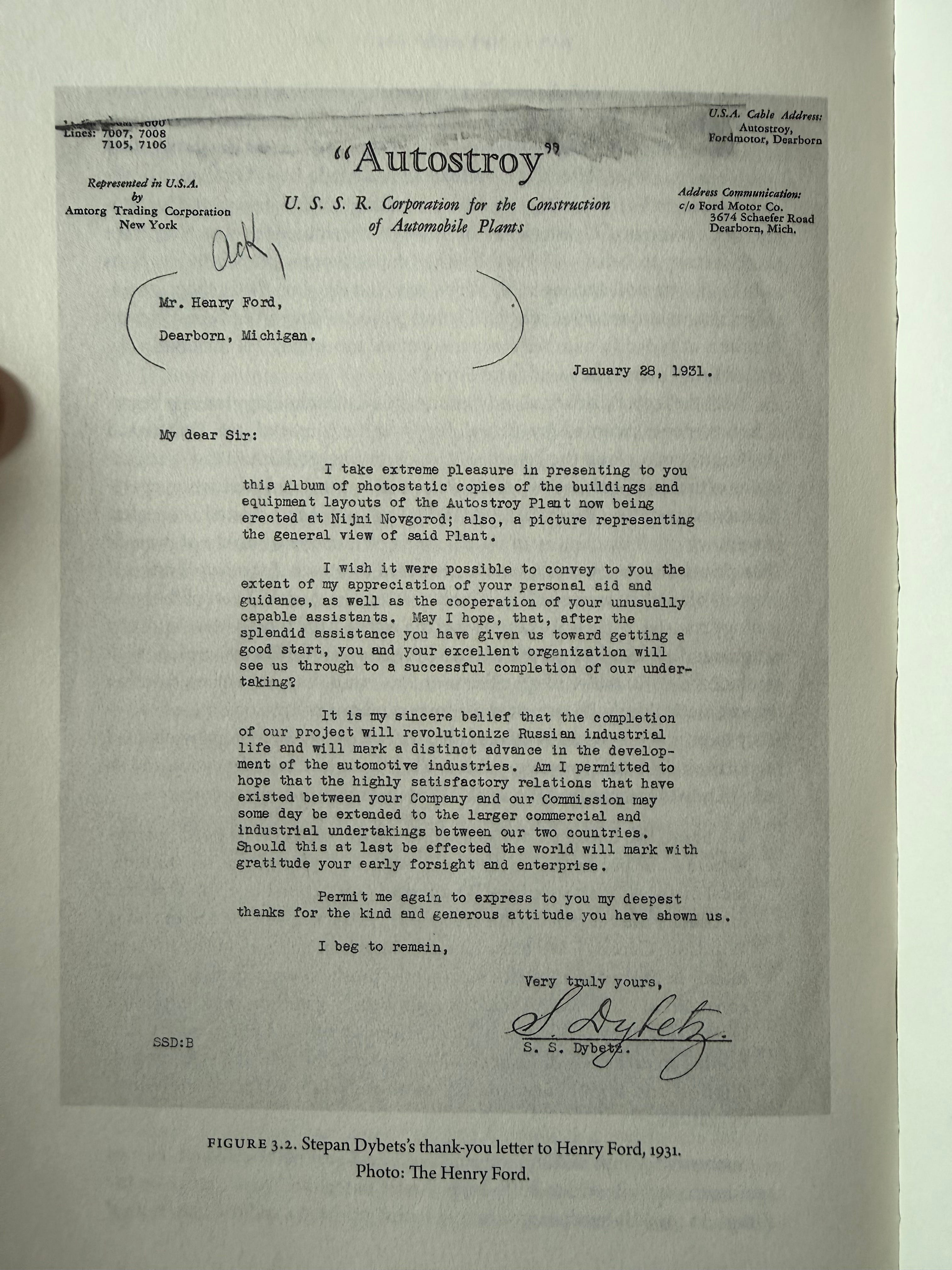
Rereading the book, a couple things stood out:
1. I hadn’t realized the alignment in economic philosophy between Ford—who in the 1930s was criticizing the gold standard and advocating that the US fund infrastructure by issuing paper money—and Stalin, Hitler, and the Japanese, all of whom also ditched the gold standard to enable funneling resources into to building industry.
2. The USSR—despite trying to replicate Ford technology, with help from Ford and U.S. trained autoworkers—in 1937 had one-third the labor productivity of Ford’s Detroit operations. Reminds me of Greg Clark’s famous study of the huge productivity gap in 19th century cotton mills, despite them using the exact same machinery.
I was most struck, though, by the similarities with today’s links between industrial capacity and national powe. In Beijing and Washington, policymakers look nervously at a “war of the factories.” Xi’s statements about the geopolitical implications of industrial capacity would not have sounded out of place in the 1930s. The tech transfer and localization requirements imposed on Ford in the 1930s look like those imposed by China on Western firms in recent decades—and those that Washington has tested recently on chip and battery firms to push them to move to the U.S. I read a lot about the ‘end of globalization’ today, but what I see in practice is remarkably similar to what Link sees in the 1930s: a “furious” effort to remake it.
perfect substack content. so happy chris is doing this!
This reminds me of the immense tech transfer opportunities of the Shanghai Gigafactory.
The Ford-Musk parallels keep giving. I don’t want to read too much into them, especially since Apple and Nvidia are just as much drivers of Chinese industrialization, but it’s excellent meme fodder