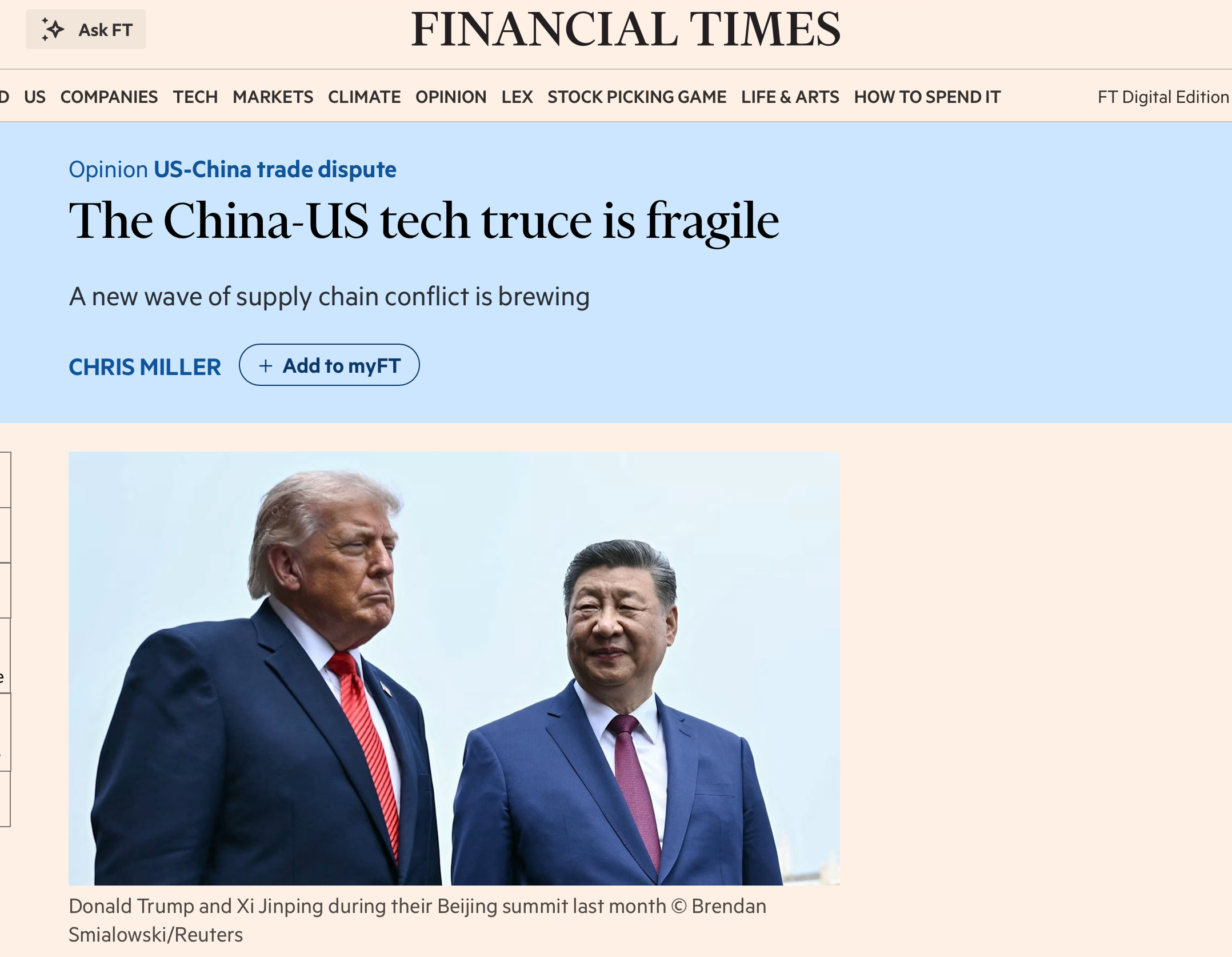
China and the U.S. have extended their tech truce, because both countries think time is on their side. Why?
I explore in an FT piece:
What is Washington’s theory of the truce? Silicon Valley types talk of being “AGI pilled” — a reference to the film The Matrix — when referring to the belief that AI will become increasingly capable and economically transformative. The US government seems to be betting that AI will dramatically enhance US power, too.
However…
Beijing doesn’t appear worried. When Chinese leaders talk about “great changes unseen in a century”, they’re not talking about AI transforming geopolitics. If Xi was worried about access to computing power, he would have accepted the Nvidia H200 chips that Trump is so keen to sell.
…
In terms of spending, China is still pouring disproportionate sums into advanced manufacturing sectors instead of AI data centres. The disruptions of Hormuz, which vindicated China’s decision to stockpile industrial inputs, resonated more strongly in Beijing than the cyber security implications of Mythos. Instead of being AGI-pilled, Xi and other Chinese leaders are industrial output-pilled. The next year will test which of these approaches is more valuable.
Check out the full piece here.
I disagree with Prof. Miller’s framing that the China-U.S. truce reflects two symmetrical theories of time: America betting on AI, China betting on industrial output.
In fact, this is an asymmetrical truce.
The deeper reason for the U.S. truce is more material: Washington needs time to rebuild vulnerable supply chains in rare earths, critical minerals, magnets, defense inputs, and other strategic bottlenecks where China still holds major leverage.
This is not simply an “AI time theory.” It is a supply-chain repair strategy.
The U.S. can talk about AI, AGI, and frontier models, but advanced AI power still depends on electricity, data centers, chips, cooling systems, transformers, rare earth magnets, grid equipment, defense-industrial capacity, and critical minerals. If these foundations remain exposed, AI leadership alone does not solve the strategic problem.
China’s reason for accepting a truce is different. Beijing does not need to rush because time is already working in its favor. China is still expanding its industrial depth, domestic substitution, energy infrastructure, advanced manufacturing capacity, EV and battery ecosystems, critical-mineral leverage, and Global South trade networks.
So this is not a truce between two equally confident theories of the future.
It is a truce in which the U.S. is trying to buy time to reduce dependence, while China is allowing time to continue compounding its structural advantages.
The real contest is not AI versus industrial output.
It is whether America can rebuild the material foundations of strategic power faster than China can consolidate them.